Associate Professor West Virginia University Health Sciences Center Morgantown, West Virginia, United States
Disclosure(s):
Elsie Barry, MD: No relevant relationships to disclose.
Meghan T. Turner, MD: No relevant relationships to disclose.
Introduction: The objective of this study is to evaluate the impact of neoadjuvant chemotherapy on overall survival (OS) of patients with oropharyngeal carcinoma (OPSCC) who receive surgery as primary treatment (NAC + S).
Methods: Systematic searches on PubMed, SCOPUS, and Web of Science were conducted from the inception of literature to December 17, 2024. Studies were included if they were cohort studies or case series of patients undergoing neoadjuvant chemotherapy with surgery as definitive treatment for OPSCC, and reported overall survival and/or disease-free survival. Studies were excluded if they were reviews or case reports, did not report survival outcomes, and were not in English.
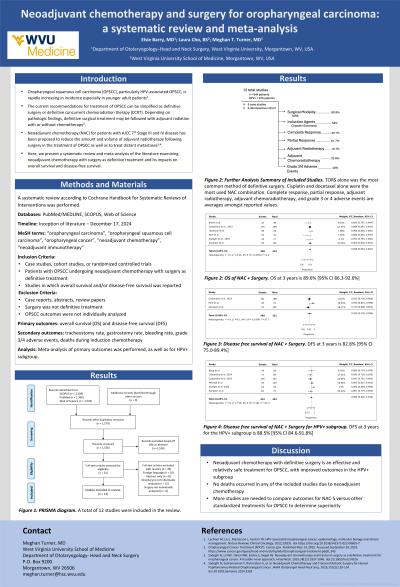
Results: A total of 11 articles with 830 patients were included. 686 of those patients were HPV-positive. Cisplatin and docetaxel were used for induction therapy in 54% of studies. TORS was used as a surgical modality in 90.9% of studies. Pooled complete response rate after NAC was 40.5%, and pooled partial response rate was 64.1%. Adjuvant radiotherapy and adjuvant chemoradiotherapy were used in 9.4% and 22.1% of patients, respectively. OS at 3 years and 5 years were 91.2% (95% CI = 84.5-96.2) and 87.1% (95% CI = 78.6-93.8%), respectively. DFS at 3 and 5 years was 82.3% (95% CI = 77.9-86.3%) and 80.2% (73.2-86.3%), respectively. OS for HPV+ subgroup at 3 years and 5 years were 95.1% (95% CI = 89.2-99) and 95.1% (95% CI = 92.9-96.9%), respectively. DFS for HPV+ subgroup at 3 and 5 years was 88.1% (95% CI = 84-91.7%) and 86.5% (81.4-91%), respectively.
Conclusions: NAC + S for patients with oropharyngeal cancer may spare patients from adjuvant therapy while maintaining good OS and DFS, especially in patients with HPV-positive oropharyngeal cancer.