UC Davis Health Department of Otolaryngology Sacramento, CA, United States
Disclosure(s):
Janeth Garcia Swartwood, MS, BS: No relevant relationships to disclose.
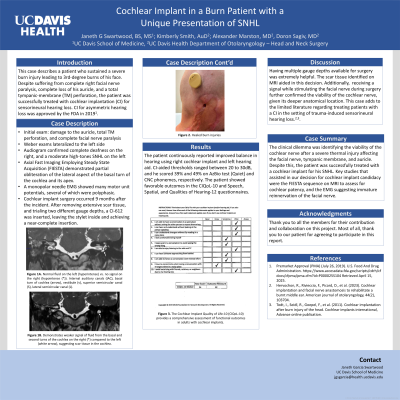
Introduction: We present a case of a patient who sustained a severe burn injury leading to 3rd-degree burns of his face. Despite suffering from complete right facial nerve paralysis, complete loss of his auricle, and a total tympanic-membrane (TM) perforation, the patient was successfully treated with cochlear implantation for sensorineural hearing loss.
Methods: Our case report describes a 38-year-old male who presented to our trauma center in March of 2024 with burn injuries involving 15% TBSA. On exam, damage to the auricle, total TM perforation, and complete facial nerve paralysis were noted. Weber exams lateralized to the left side. An audiogram confirmed complete deafness on the right, and a moderate high-tones SNHL on the left. Axial Fast Imaging Employing Steady State Acquisition (FIESTA) demonstrated partial obliteration of the lateral aspect of the basal turn of the cochlea and its apex. A monopolar needle EMG showed many motor unit potentials, several of which were polyphasic. The patient underwent cochlear implant surgery 9 months after the incident. After removing extensive scar tissue, and trialing two different gauge depths, we proceeded with CI-612 insertion, leaving the stylet inside and achieving a near-complete insertion.
Results: During cochlear implant activation, implant tests indicated normal performance for all 22 intracochlear and the 2 extracochlear electrodes. Impedance levels were high and variable, as expected. Magnet strength assessment determined that 3 and 4i were appropriate for good retention. The final audiological outcomes are still underway and will be presented at the conference.
Conclusions: We encountered a clinical dilemma regarding the viability of the cochlear nerve after a severe thermal injury affecting the facial nerve, tympanic membrane, and auricle. Despite this, the patient was successfully treated with a cochlear implant for his SNHL. Key studies that assisted in our decision for cochlear implant candidacy were the FIESTA sequence on MRI to assess for cochlear patency, and the EMG suggesting immature reinnervation of the facial nerve.


.jpg "Janeth Garcia Swartwood, MS, BS photo")