Seetha Aribindi, n/a: No relevant relationships to disclose.
Introduction: Vice chairs (VCs) of research are integral to advancing the mission of academic otolaryngology departments. They provide strategic oversight for research initiatives and support the educational development of faculty and trainees. Despite their significance, little is known about these leaders in otolaryngology. This study characterizes their academic and demographic attributes.
Methods: Otolaryngology residencies in the U.S. were identified using Doximity. Program and personal websites were systematically reviewed to identify VCs of research and faculty who held equivalent positions and collect academic and demographic data. The Scopus database, National Institutes of Health (NIH) RePORTER, and Google Scholar were utilized to obtain each investigator's Hirsch index (h-index) and information on NIH grant awards.
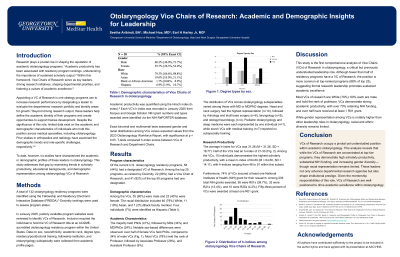
Results: Among 131 otolaryngology residency programs, 58 (44%) had a designated VC of research, including 22 (88%) of the top 25 programs. VCs were predominantly male (60%) and White (79%), with smaller representations of Asian (19%) and Black individuals (2%). Most held the rank of professor (60%), followed by associate professor (28%), and assistant professor (9%). The majority were PhDs (41%), followed by MDs (34%) and MD/PhDs (24%). The average h-index for VCs was 34.1. Furthermore, 74% had secured at least one NIH grant, with 53% having been awarded at least one R01 grant.
Conclusions: Otolaryngology VCs of research and faculty in equivalent roles are crucial in heading research initiatives, securing funding, and enhancing the reputation of academic otolaryngology programs. Most VCs of research are White (79%); 60% each are male and hold the rank of professor. Over half have been awarded at least 1 R01 grant from the NIH, underscoring their significant contributions to advancing research.