Associate Professor Kyung Hee University School of Medicine Seoul, United States
Disclosure(s):
Jin-Young Min, MD: No relevant relationships to disclose.
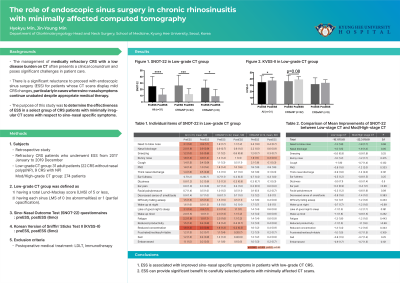
Introduction: It is common to encounter patients with symptoms suggestive of chronic rhinosinusitis (CRS), however CT evaluation shows mild mucosal disease. Even though sino-nasal symptoms failed to resolve after medical therapy, there is often a reluctance to perform endoscopic sinus surgery (ESS) for patients with mild CRS demonstrated in CT scan. The purpose of this study was to determine the effectiveness of ESS in a select group of patients with mild CRS with respect to sino-nasal specific symptoms.
Methods: Of the CRS patients who underwent ESS from 2017 January to 2019 December, 48 adult patients (29 CRS without nasal polyp [CRSsNP] and 19 CRS with nasal polyp [CRSwNP]) with mild extent of disease burden determined by preoperative CT scans were enrolled in this study. Mild extent of disease burden was defined as 1) having a total Lund-Mackay score (LMS) of 5 or less, 2) having each sinus LMS of 0 (no abnormalities) or 1 (partial opacification). Symptoms and satisfaction based on the Sino-Nasal Outcome Test (SNOT-20) questionnaires were assessed before ESS and compared after 3-month follow-up as well as long-term follow-up.
Results: Compared to preoperative SNOT-20 scores, there was statistically significant improvements in total scores of SNOT-20 in CRS patients with minimally affected CT scans after ESS (26.917.44 vs 11.779.14, P< 0.0001) at postoperative 3-month. Similarly, clinically significant SNOT-20 improvements occurred in both CRSsNP and CRSwNP (all, P< 0.05). When we assessed 20 individual symptoms, statistically significant decreases were found across all symptoms associated with CRS (all, P< 0.05), with the exception of earfullness, ear pain, and facial pain/fullness. Furthermore, of the individual symptoms, large effect sizes were noted for decreases in symptoms in need to blow nose (-1.16), cough (-1.1), fatigue (-1.26), and reduced concentration (-1.32). Additionally, similar trends were maintained up to 38 months postoperatively.
Conclusions: ESS can provide significant relief of sino-nasal symptoms in selected CRS patients with minimally affected CT scans.