


Clinical Assistant Professor University of Michigan Ann Arbor, Michigan, United States
Disclosure(s):
Tirth R. Patel, MD: No relevant relationships to disclose.
Renee M. Banakis Hartl, MD: No relevant relationships to disclose.
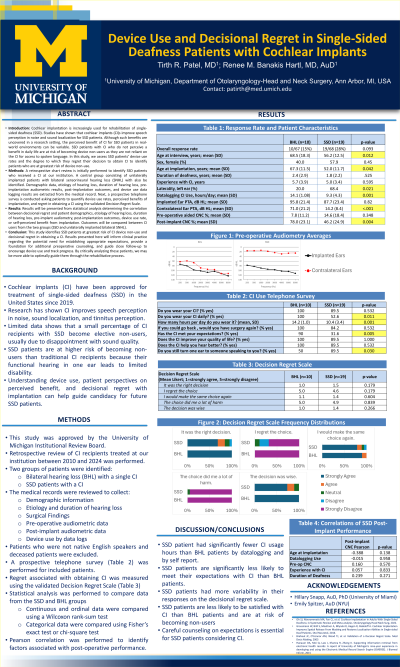
Introduction: Cochlear implantation is increasingly used for rehabilitation of single-sided deafness (SSD). Studies have shown that cochlear implants (CI)s improve speech perception in noise and sound localization for SSD patients. Although such benefits are uncovered in a research setting, the perceived benefit of CI for SSD patients in real-world environments can be variable. SSD patients with CI who do not perceive a benefit in daily life are at risk of becoming device non-users as they are not reliant on the CI for access to spoken language. In this study, we assess SSD patients’ device use rates and the degree to which they regret their decision to obtain CI to identify patients who are at greatest risk of device non-use.
Methods: A retrospective chart review is initially performed to identify SSD patients who received a CI at our institution. Demographic data, etiology of hearing loss, duration of hearing loss, pre-implantation audiometric results, post-implantation outcomes, and device use data logging results are extracted from the medical record. Next, a prospective telephone survey is conducted asking patients to quantify device use rates, perceived benefits of implantation, and regret in obtaining a CI using the Decision Regret Scale.
Results: Results will be presented from statistical analysis determining the correlation between decisional regret and patient demographics, etiology of hearing loss, duration of hearing loss, pre-implant audiometry, post-implantation outcomes, device use rate, or self-perceived benefit from implantation.
Conclusions: This study identifies SSD patients at greatest risk of CI device non-use and decisional regret in obtaining a CI. These patients may require additional counseling prior to obtaining a CI to determine what may be the best rehabilitative option for them. If CI is pursued, these patients may benefit from close follow-up to encourage device use and track progress.