Physician Multicare Spokane , Washington, United States
Disclosure(s):
Mahimna Pandya, B.S. B.A: No relevant relationships to disclose.
Brian Mitchell, DO: No relevant relationships to disclose.
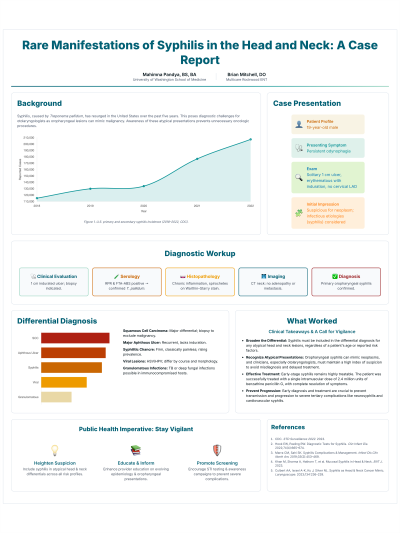
Introduction: Syphilis, caused by Treponema pallidum, is known as “The Great Imitator” due to its diverse clinical manifestations. This case report highlights an unusual oropharyngeal presentation of syphilis, initially mistaken for a neoplastic lesion, emphasizing the necessity of including syphilis in differential diagnosis of head and neck lesions regardless of traditional risk factors.
Methods: This is a case report of A 19-year-old male presented to the otolaryngology clinic with a two-week history of persistent odynophagia localized to the tonsillar and pharyngeal regions. Physical examination revealed a solitary ulcerative lesion on the posterior soft palate with erythema and indurated borders, raising suspicion for a neoplastic process. Comprehensive evaluation included serologic testing (RPR, FTA-ABS), which confirmed primary syphilis. A biopsy with Warthin-Starry staining identified Treponema pallidum, differentiating it from malignancy. Literature review was conducted to contextualize this rare presentation within the increasing incidence of extragenital syphilis.
Results: Serologic assays confirmed primary syphilis. Histopathological analysis showed chronic inflammation with spirochetes consistent with Treponema pallidum infection. Imaging studies ruled out cervical lymphadenopathy and systemic involvement, supporting a localized oropharyngeal syphilis diagnosis. Treatment with benzathine penicillin G led to complete symptom resolution, with no recurrence at one-month follow-up. The case underscores the diagnostic challenge of oropharyngeal syphilis and the importance of considering it in differential diagnoses of head and neck ulcers.
Conclusions: This case illustrates an uncommon oropharyngeal manifestation of syphilis mimicking neoplastic lesions, highlighting the need for clinicians to maintain a broad differential diagnosis for head and neck lesions. Given the rising incidence of extragenital syphilis, heightened clinical awareness and prompt diagnostic evaluation are essential to ensure timely treatment and prevent complications.