Professor HNSCS Duke Health Durham, NC, United States
Disclosure(s):
Bhavik Singh, OMS-III: No relevant relationships to disclose.
Eileen M. Raynor, MD: No relevant relationships to disclose.
Introduction: Nodular lymphocyte-predominant Hodgkin lymphoma (NLPHL) is a rare subtype, representing 5% of Hodgkin lymphoma cases and It is distinguished by lymphocyte-predominant cells expressing CD20 and CD79a but not CD15 and CD30. Pediatric NLPHL affects primarily males aged 4–17, often presenting with localized lymphadenopathy and favorable outcomes. NLPHL’s distinct pathology makes treatment optimization critical, long-term risks of chemotherapy and radiotherapy have led to interest in surgical resection for low-risk, early-stage disease.
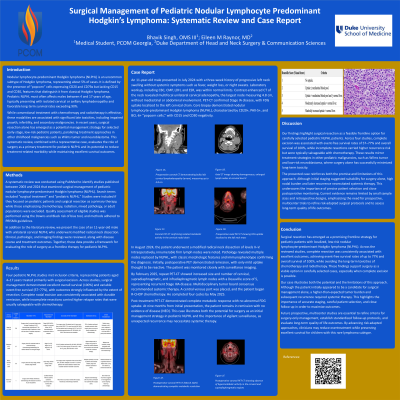
Methods: We conducted a systematic review of studies on pediatric NLPHL with a focus on surgical resection. PubMed searches identified 34 studies, of which 4 met the inclusion criteria. Data regarding surgical outcomes, recurrence rates, and survival were extracted. Additionally, we analyzed our own case study of an 11-year-old male who underwent modified neck dissection followed by radiotherapy due to residual disease found on PET.
Results: Surgical resection was associated with event-free survival rates of 57–77% and 100% overall survival in low-risk patients. Complete resection reduced recurrence risk, while incomplete resections required adjuvant therapies. Our case study demonstrated that adjunctive radiotherapy could achieve remission when residual disease is present after surgical resection. This highlights the importance of individualized care based on disease presentation.
Conclusions: Surgical resection shows promise for treating early-stage pediatric NLPHL, offering a pathway to reduce long-term complications of standard therapies. Our findings, including the case study, highlight the role of surgery as part of a multimodal approach. Future research should refine pediatric-specific treatment protocols to maximize survival and minimize late effects, ensuring optimal long-term quality of life for patients.