Professor Chosun University Hospital Gwangju, United States
Disclosure(s):
Ji Yun Choi, MD: No relevant relationships to disclose.
Introduction: Many Asians have noses with a broad alar base. Alar base surgery create an aesthetically balanced alar base is an important supplementary surgical technique in rhinoplasty performed on Asian patients. For proper assessment of the nasal base width, a clear distinction should be made between the width of the alar base and the degree of alar flare.
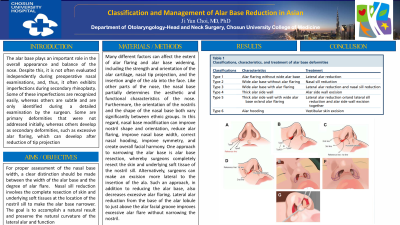
Methods: In Asian patients, alar base surgery can be classified into 6 types depending on which segment of the alar base is to be reduced. Type 1 comprises long, flaring alar without wide alar base and can be corrected using lateral alar reduction. Type 2 includes wide alar bases or excessive nostril sills without flaring and can be corrected using nasal sill reduction. Type 3 is a combination of types 1 and 2. Type 4 consists of caseswithathickalarsidewall andcanbecorrected using alar side-wall excision. Type 5 denotes any combination of types 1, 2, or 3 with type 4, and type 6 refers to cases of alar hooding. These can be corrected using vestibular skin excision.
Results: Our goal is to accomplish a natural result and preserve the natural curvature of the lateral alar and function. Regardless of the type of modification, a conservative approach to alar base refinement is essential. Nasal sill reduction which involves the complete resection of skin and underlying soft tissues at the location of the nostril sill made the alar base narrower. Lateral alar reduction from the base of the alar lobule to just above the alar facial groove will improve excessive alar flare, but will not narrow the nostril.
Conclusions: Nasal base modification can improve nostril shape and orientation, reduce alar flaring, improve nasal base width, correct nasal hooding, improve symmetry and create overall facial harmony. For the correction of alar rim deformities, careful examination, consultation, analysis and consider the condition of the skin are essential. Understanding of the ala and surrounding tissue, supporting of lower lateral cartilage, selecting the proper technique produces functionally and aesthetically good results.